Where Did the Term the South Will Rise Again Come From
Jefferson Davis Hopes the "Oppressed South" Shall "Rising Again"
While he awaits trial for treason, Davis writes a shut friend lamenting the "Radical" rule of the Republicans and the state of the southland.
A very early utilize of this at present famous phrase
The expression "The south shall rise over again" is 1 that anybody has heard, not merely in the southern states only throughout the entire nation. Information technology has been used as a political slogan, a regional emblem, a football battle weep, and even...
Read More
A very early on utilise of this now famous phrase
The expression "The due south shall rise once again" is one that everyone has heard, not only in the southern states but throughout the entire nation. Information technology has been used as a political slogan, a regional emblem, a football battle cry, and even been the title of a 1950s song ("Salve Your Amalgamated Coin Boys, The Due south Shall Rise Again"). Notwithstanding, the expression is not a contempo one; its genesis dates back to the turbulent years direct following the Ceremonious War.
In the late 1860s and early 1870s southern Democrats began to proceeds more political forcefulness as former Confederates were once again given the right to vote. During this time, across the Due south, people known to history as the Redeemers came into prominence. The Redeemers actively promoted a return to conservative Autonomous rule and opposed the Republican-led, federally-imposed local and state governments, which they saw as decadent and a violation of true principles. They were also defended to white dominance and sought to deny blacks whatsoever function in the new Due south. Many of the Redeemers were plantation owners and other wealthy elites who had lost power and wealth during the Civil War, onetime Confederate soldiers and loyalists, and a wide variety of supporters. From 1868, they used violence, intimidation and fifty-fifty fraud to command or sabotage any ballot they could not influence, the goal existence to reduce Republican voting and oust current officeholders. In 1868 alone, there were over 1,000 political murders in Louisiana, most of the victims being freedmen. The motto and rally cry that the Redeemers adopted was "the South shall rise once again," and this became something of a motto for the area, one that was at times used by candidates to stir up racial and regional confrontation. It has retained its currency into the 21st century.
Before the Civil State of war, Jefferson Davis seved as Secretarial assistant of the Navy under President Franklin Pierce. While in this position he met and befriended America's first Assistant Secretary of State, Ambrose Dudley Mann. During the war, Confederate President Davis appointed Mann as one of the first Commissioners to Europe and Mann eventually gained the title of Amalgamated Commissioner for Belgium and the Vatican.
After Lee'southward surrender at Appomattox, Davis fled Richmond and was captured by Federal cavalry virtually Irwinville, Georgia on May 10, 1865. He was then held at Fort Monroe on charges of treason against the U.s.a. until May of 1867, when he was released on a $100,000 bond. The bond was posted past several prominent Americans, amidst them his wartime opponents Horace Greeley, Cornelius Vanderbilt and Gerrit Smith. Though a public trial was something Davis eagerly sought because it would raise the issue of whether or not secession was really illegal no less treasonous, it was long delayed. Meanwhile, he refused to apologize or consider ideas of a pardon.
In 1868, after spending fourth dimension in New Orleans and Canada, Davis and his married woman traveled to Europe. He wanted to call on Mann, who had moved to Paris subsequently the state of war, but serious illness in his family prevented it. In this important letter, Davis explains all that, mentions his own ill health (no doubt worsened past the physical and mental strain of his confinement and constant travels), and clearly describes his family's reduced straits and meager budget. He laments the delays in and inconveniences of his upcoming trial, which were in part the upshot of the unavailability of Master Justice Salmon Hunt, who was presiding over the trial afterward impeachment of President Andrew Johnson. Davis also decries the "radical rule" of the Federal government, and with the U.S. presidential ballot of 1868 just ahead, he doubts that New York Governor and Democratic candidate Horatio Seymour can defeat the popular Republican candidate, U.S. Grant. This leads him to regret the condition of the South, wondering if information technology will e'er have the "life to rise once again."
Shorthand Letter Signed, Waterloo, England, Oct 9, 1868 to Mann. "My dearest friend, I have long desired to write to yous simply having learned that yous had changed your residence was at a loss how to address you, until I met our friend Senator [James A.] Bayard at London. Immediately thereafter I returned to Liverpool and learned that my son who was at school at this place was dangerously ill, and on my arrival hither found him so low that for weeks we had more to fearfulness than to promise. He is at present ambulatory but my wife is quite ill, probably consequent on fatigue and feet, and I have suffered from the disease which has afflicted this village. You volition I hope alibi the filibuster in announcing myself to you and believe that one of our great desires in Europe was to meet you again. It was my intention to leave France earlier this date but all of my plans take been disturbed for the causes already stated. The U.S. Court before which I am under bond to appear meets again on the 23rd of Nov and unless notified that my presence is not required I shall have to be in Richmond, Va. at that time. My counsel expected to receive notice dispensing with my attendance because the case would not be tried in the absence of the circuit judge, the Chief Justice Chase, and it was well understood that he could not preside in the Excursion Court, because the term of the Supreme Court would commence in the ensuing week. Having yet been compelled on the 2 erstwhile occasions to go to Richmond and when it was known there would be no hearing, it may be that a like needless journey will again be necessary.
"Equally presently every bit the wellness of my family will let it is our purpose to leave here, going in the first case probably to Leamington, and after a short stay there I wish to go to French republic. My object is to locate my family in some healthy place where they may live at such modest expense as our circumstances will permit, and where the children may have good schools accessible from their Mother'south lodgings. We accept looked to you for information and advice. I need not say that the lowest rates consistent with comfort will exist accepted.
"The American newspapers have not recently encouraged the hope of Seymour'south election, I cannot bear to contemplate another four years of 'Radical' dominion. Their crimes would probably lead to a terrible reaction and their punishment would be more full and therefore more beneficial to the oppressed South, if it were possible to wait and then long and yet accept life to rise again. Mrs. Davis presents to you her kindest remembrance…I am your friend, Jeff'due north Davis."
The sentiment in this letter is overwhelming, with Davis feeling persecuted, impoverished, and powerless, even equally his worst adversaries maraude through the south and prepare to inaugurate Grant and his Republicans into the Execute Mansion. Moreover, considering the timing of this letter of the alphabet, the very language with which it ends is startlingly consistent with the rally weep of the Redeemers – "The south shall ascension once more" – which raises some interesting potentialities. If Davis borrowed the expression from the Redeemers in composing this letter, that would tend to indicate that he was in sympathy with them and their program. On the other hand, its use here may bespeak that Davis himself had something to do with the phrase's origin. Although its exact genesis is not known, it is possible that some unknown person within the Redeemers originated it. Some other scenario is that information technology was adopted from an early version of a quote that Jefferson Davis used in 1873, and which he borrowed from Thomas Carlyle: "Truth crushed to earth volition rising over again." Plus there is the intriguing possibility that the language of this very letter may have been published in southern newspapers at the time and resulted in creation of the phrase.
The Supreme Court eventually dismissed the charges against Davis, though his U.Due south. citizenship was just restored posthumously.
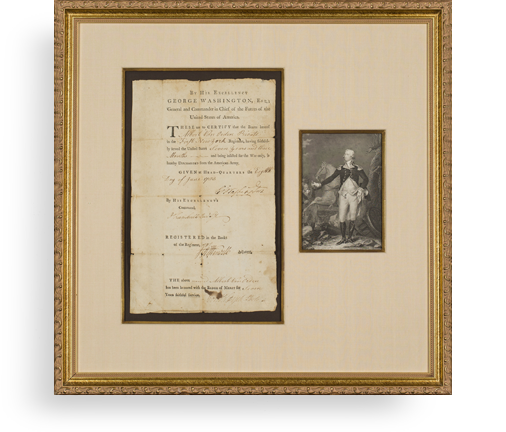
Frame, Display, Preserve
Each frame is custom constructed, using only proper museum archival materials. This includes:The finest frames, tailored to friction match the document you have called. These can period style, antiqued, gilded, wood, etc. Fabric mats, including silk and satin, besides as museum mat board with manus painted bevels. Zipper of the document to the matting to ensure its protection. This "hinging" is washed according to archival standards. Protective "glass," or Tru Vue Optium Acrylic glazing, which is shatter resistant, 99% UV protective, and anti-reflective. You do good from our decades of experience in designing and creating beautiful, compelling, and protective framed historical documents.
Larn more about our Framing Services
farrisrhallithe68.blogspot.com
Source: https://www.raabcollection.com/jefferson-davis-autograph/oppressed-south-shall-rise-again
0 Response to "Where Did the Term the South Will Rise Again Come From"
Post a Comment